This is the home of the University of Chester Surface Science and Engineering research group. We are a collective, based within the department of Physical, Mathematical, and Engineering Sciences within the Faculty of Science, Business, and Innovation, who specialise in different areas of surface science. These range from growth of nanostructures, laser engineering, surface analysis, thin-film deposition, microbiological attachment, and a host of other exciting areas. We aim to work with both commercial and academic research partners. For more information about who we are, what we do, and where to find us please click the relevant tabs within the about section. For our research interests, please select the relevant section for more information about our specialties, as well as what we can offer on a commercial basis, or for information on our role assisting with the Faculty’s teaching. Lastly for our latest news and updates please see either the front page or our news archive.
Interested in working with us? E-mail: s.hodgson@chester.ac.uk
We are based in within the University of Chester’s Faculty of Science, Business, and Innovation, on the Parkgate Road campus close to the centre of Chester. Undergraduate Teaching Labs are located in the NowFood building, Offices in Westminster building, and the new Surfaces lab is currently under construction as part of the design and manufacturing suite.
Listed below are the current associated academics, research staff, and project students along with their current research interests. Clicking on each individual’s name will take you to their staff page, and on their areas of collaboration with us to their Google Scholar page (where applicable).
Academic Staff
Alice Gillett (Microbiological Attachment, Wettability)
Dr. Gavin Hazell (Functional Nanomaterials, Antimicrobial Surfaces)
Dr. Simon Hodgson (Surface Structuring, 3G Photovoltaics)
Prof. Graham Smith (Surface Micro-analysis, Materials Imaging)
Current Students
Alice Gillett (PhD)
Stephen Davies (MRes)
Fin Gale (MRes)
Arjun Anilkumar (MSc)
Susie Hall (MSc)
Sneka Jayaraman (MSc)
Benjamin Atkinson (3rd year project)
Samuel Baker (3rd year project)
Martyn Crossley (3rd year project)
Ian Darwood (3rd year project)
Kamal El Rhamy (3rd year project)
Amr Hamza (3rd year project)
Michaela Hanson (3rd year project)
Cyril Jacob (3rd year project)
Megan Kettle (3rd year project)
Benjamin Palacio (3rd year project)
Kawtar Sebbar (3rd year project)
Hannah Sturgeon (3rd year project)
Stephanie Wakelam (3rd year project)
Merita Zemliauskai (3rd year project)
Past Staff & Students
Staff 2019 Dr. Radhika Bava – Research Asst. – Laser processing for active food packaging Postgraduate Research Students 2020 Hannah Eccleston – MRes (distinction) – Fabrication of anti-biofouling surfaces for application of marine renewable energy devices 2018 Chi-Ho Ng – MPhil – Laser Surface Modification of NiTi for Medical Applications Completed Final Year Project Students 2022 Matthew Brierley – Microemulsions of menthol in sports science Ben Brooks – Improving the wettability of polyethylene terephthalate fabric by adopting laser irradiation to enhance surface silver nanoparticle deposits Noah Duffy – Designing a table-top hybrid manufacturing capability for use within a small-medium enterprise Ryan Martin – Solar power: The energy source with untapped potential Matthew Scott – A feasibility study of low power CO2 laser welding and comparative assessment with gas metal arc welding Robert Skelding – Bioinspired copper nanostructures 2021 Lauren Friel – Laser processing of submicron hydroxyapatite spheres with embedded silver nanoparticles for use in implants with antimicrobial properties Matthew Griffiths – Copper-based nanowire materials through a templated synthesis Ryan Shipley – Pulsed laser processing of glass to improve solar cell performance by photon management Samuel Williams – Bioinspired copper nanostructures 2020 Caolan Brazier – Creating anti-microbial surfaces through embedding silver nanoaprticles using an Nd:YAG laser Emma Dunham – Using neural networks to predict the wettability of laser processed materials Carrick Hurley – Laser fabrication of submicron copper nanospheres from nanopowder, for use as a lubricant additive to reduce friction, and wear of steel surfaces Megan Johnstone – Improved photon management in PV applications by laser induced internal modification of glass substrates Lydia Kinman-Carroll – Harvesting of water from fog clouds via a system of hydrophilic and hydrophobic areas Jack Nash – Design process of a dip coater designed for academic study Jordan Williams – Formation of nanostructures on a copper surface through an electrochemical process using various catalysts 2019 Christian Mamwell – Enhancing light scattering through laser texturing of glass substrates Robert Marvin – Hydrothermal synthesis of titanium nanowires for bactericidal surfaces inspired by nature Neil Wilks – Hydrophobic qualities of polymer surfaces generated through production using a metal mould 2017 Saleh Al-Marri – Enhancing the wettability of polyethylene (PE) by laser processing Abdulla Alsuwaidi – Investigation in improvements of surface properties of aluminum composite material subjected to laser shock peening Chris Packer – Laser surface engineering for the manipulation of wettability characteristics in PET (Polyethylene Terephthalate) Gregario Romairone – CO2 laser surface modification of Nylon 6,6 and the influence surface wettability, roughness and energy have on the adhesive properties Yousef Shamiyeh – Laser processing to enhance the hydrophobicity of PTFE
We have a new laboratory currently under construction as part of the Design and Manufacturing Suite. This will house many of our laser systems as well as provide some space for chemical processes. We have access to the University’s full range of characterisation tools (see the materials characterisation section on the ‘commercial’ tab for more details). Below is a list of our laser systems:
CO2 Laser Markers & Cutters (50 & 60 W)
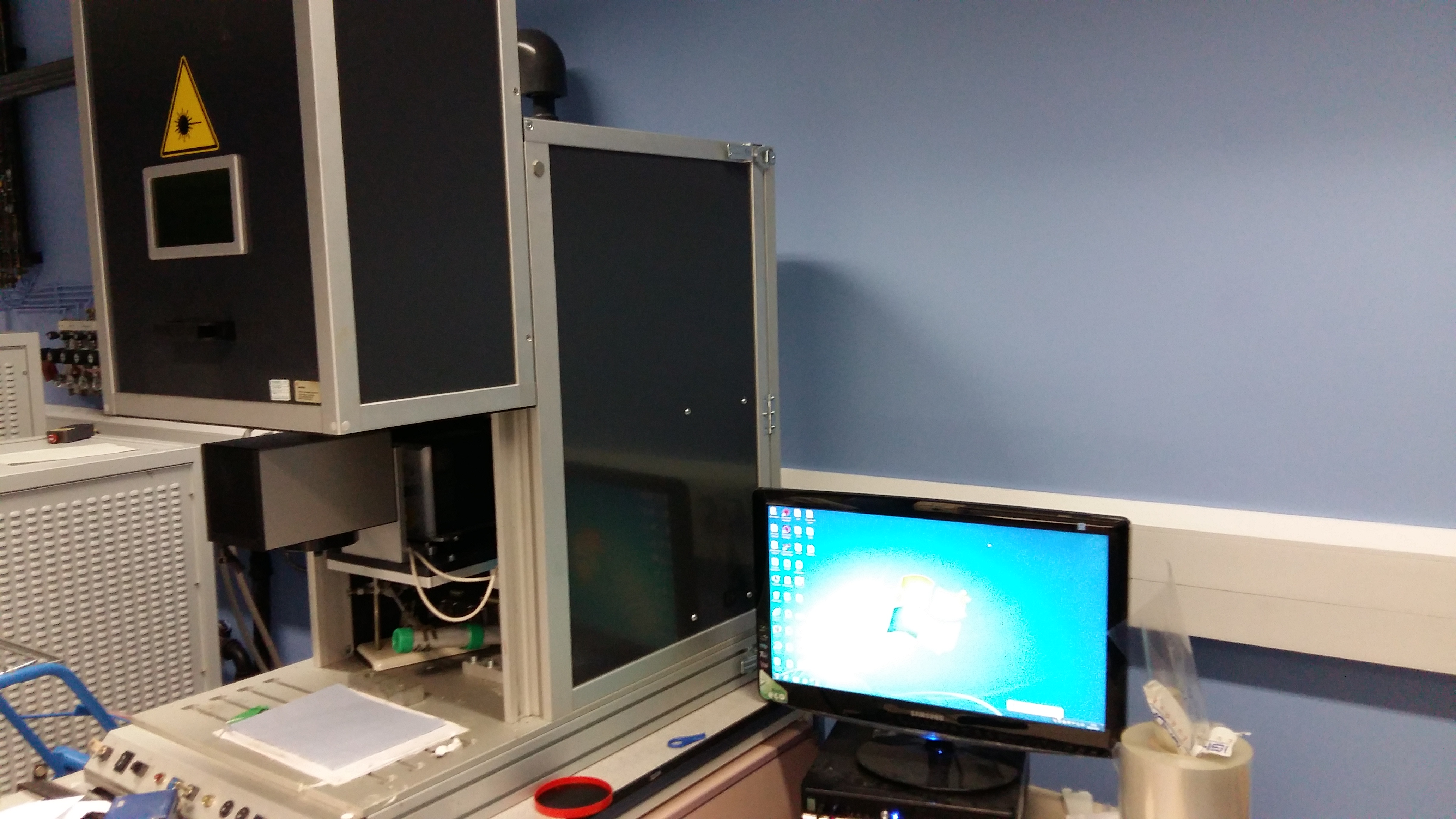
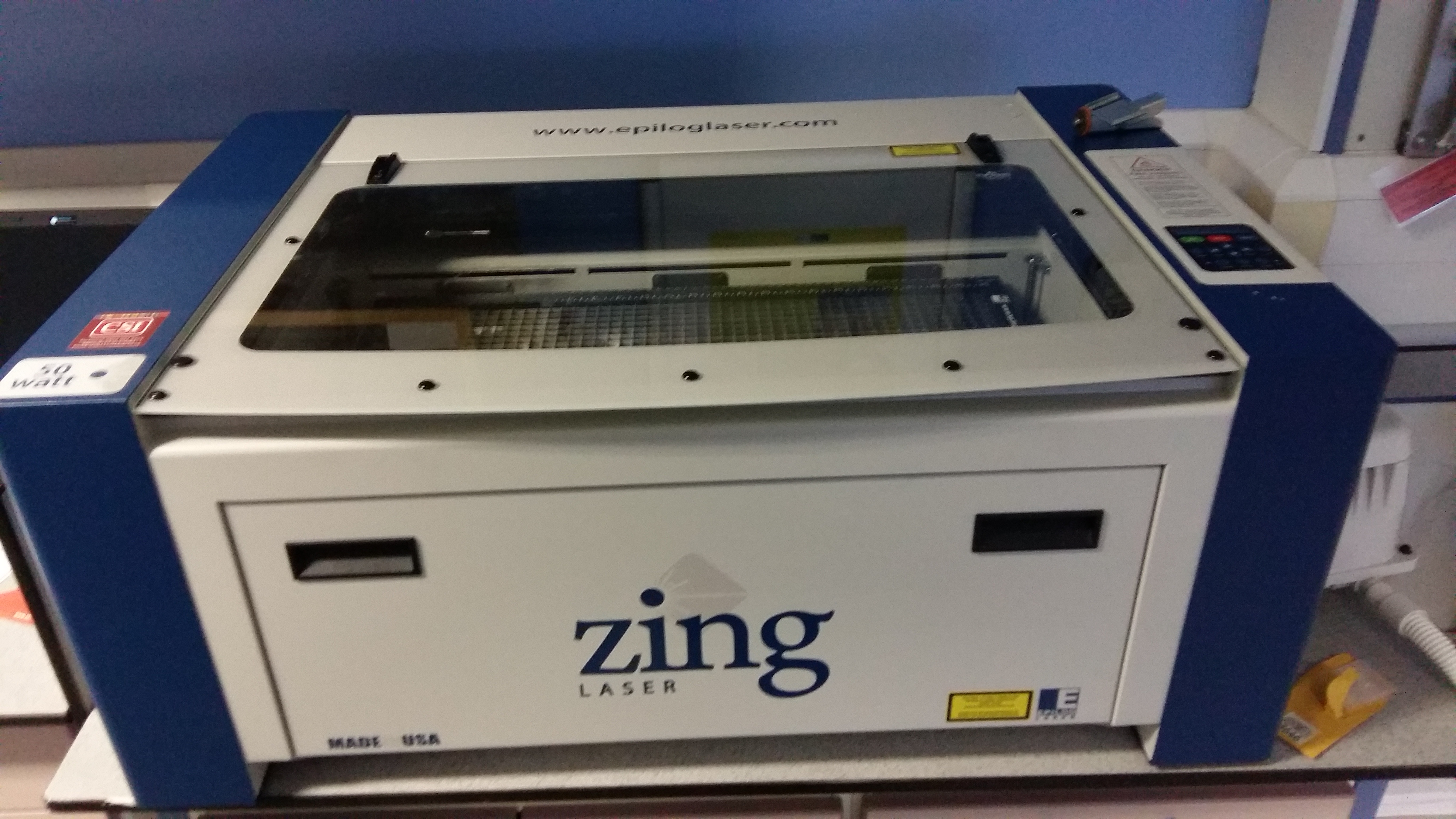
Here in the surfaces group we are fortunate to have two versatile CO2 laser systems. These are the 60 W Synrad Firestar series marker, powered by WinMark software, and the 50 W Epilog Zing series engraver/cutter that is compatible with most graphic software (Corel Draw, Photoshop etc.).
The Synrad Firestar series laser marker has an FH Flyer galvanometric scanning head that enables complex shapes and patterns to be drawn on a variety of materials all controlled by the WinMark software. The laser has an adjustable spot size that ranges from a minimum of ~171 μm (FWHM, ~290 μm 1/e2) and can be operated in both continuous wave (cw) and pulsed modes.
Laser Wavelength: ~10.6 μm
The Epilog Zing uses high-speed stepper motors to produce high resolution cutting and engraving. With an air-assist curtain for cleaner cutting, a rotary stage for engraving rounded surfaces and compatibility with standard graphical software the Zing is excellent at producing high quality engraved images. Our Zing is loaned to the design suite for manufacturing use.
Laser Wavelength: ~10.6 μm
Fibre Laser (300 W)
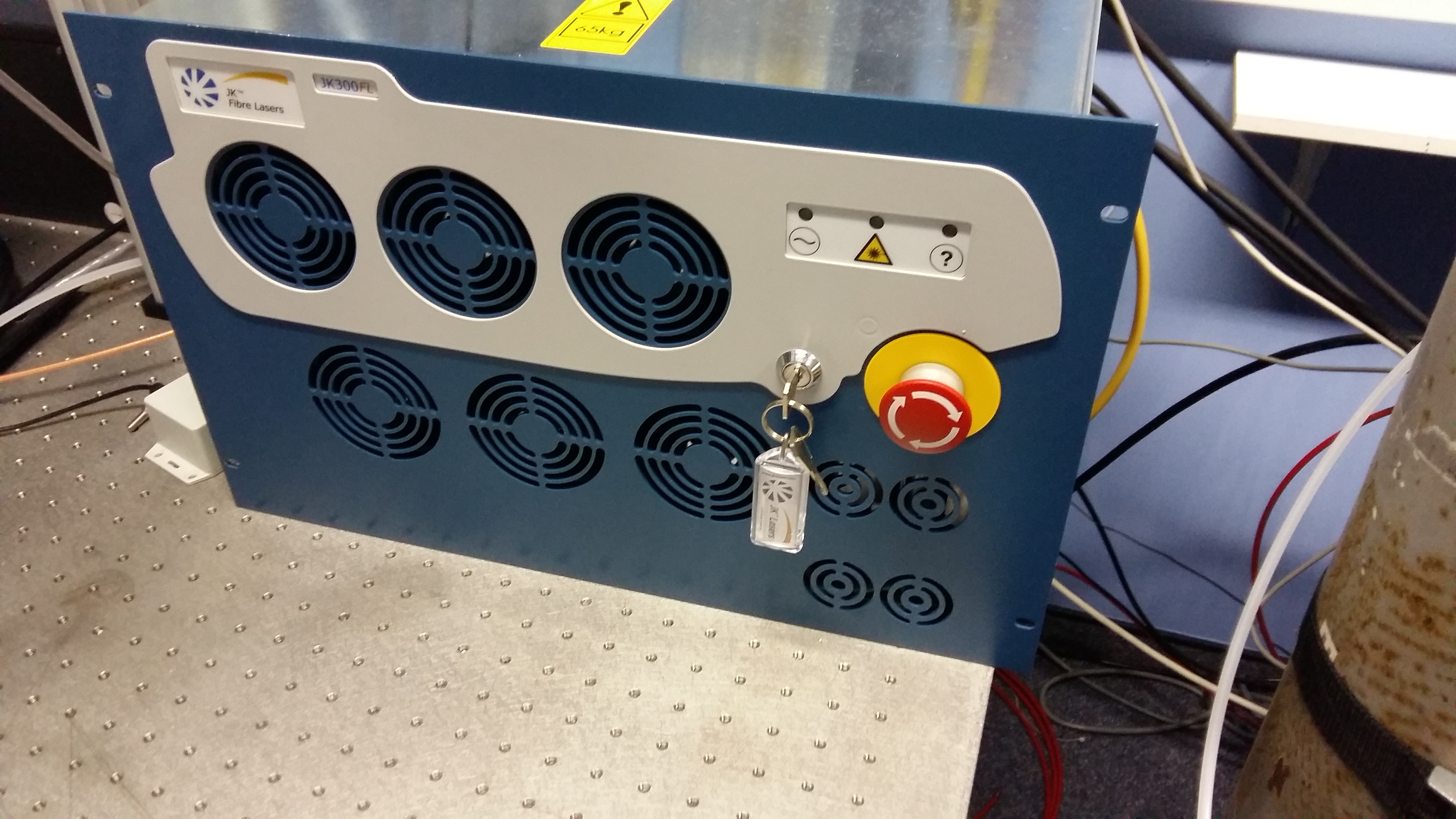
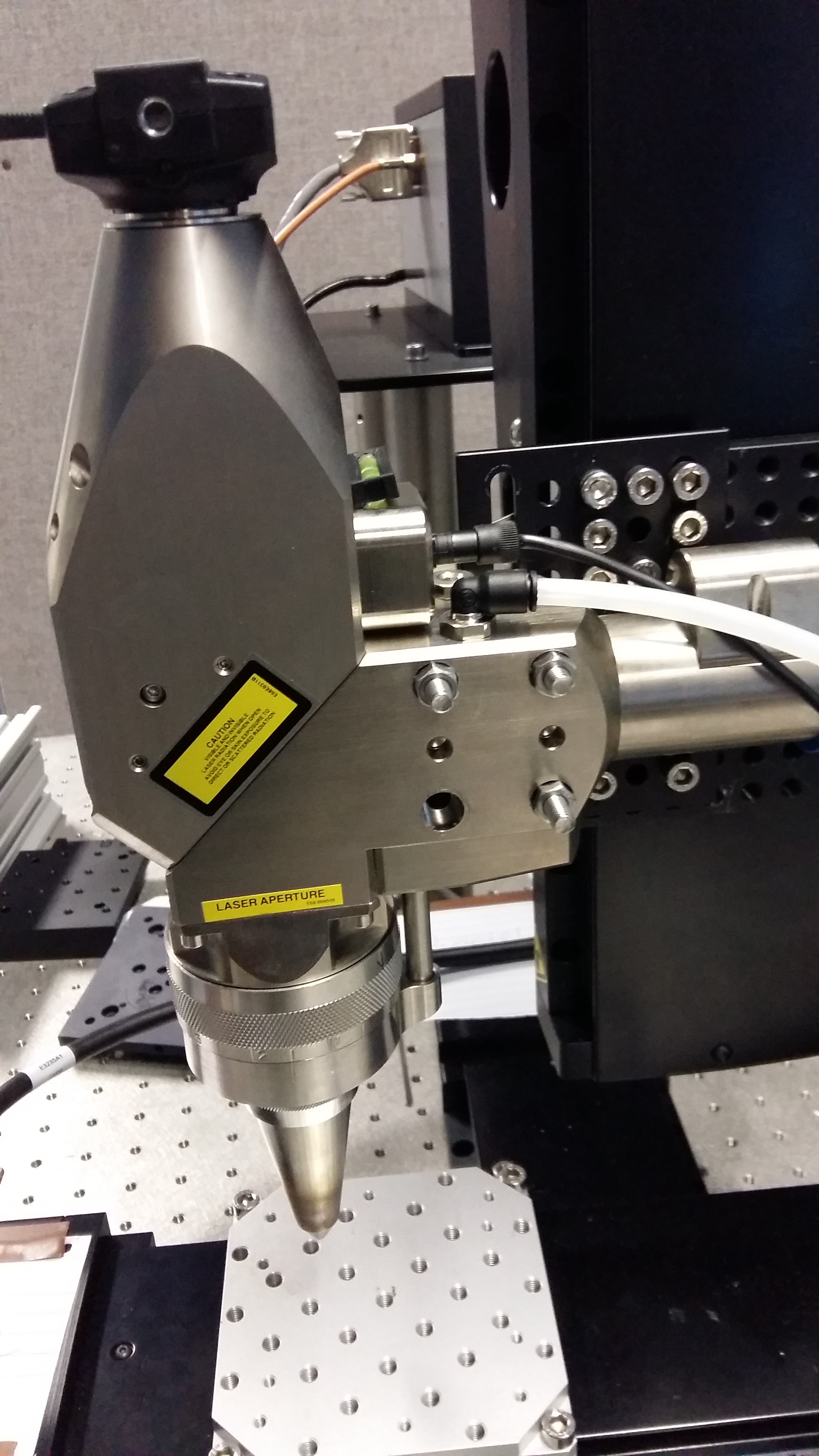
The JK300FL from JK lasers (now SPI), is a 300 W fibre laser with a specialised cutting and welding head. The cutting head, in addition to producing small spot sizes ideal for cutting and welding applications, uses compressed air as an assist gas and has a ‘through the lens’ CCTV viewing system to assist with alignment and process control when high accuracy is required. The laser can be operated in three modes: continuous wave (cw), modulated and pulsed.
Laser Wavelength: 1070 nm
Picosecond Laser (<5 ps, ~10 μJ)
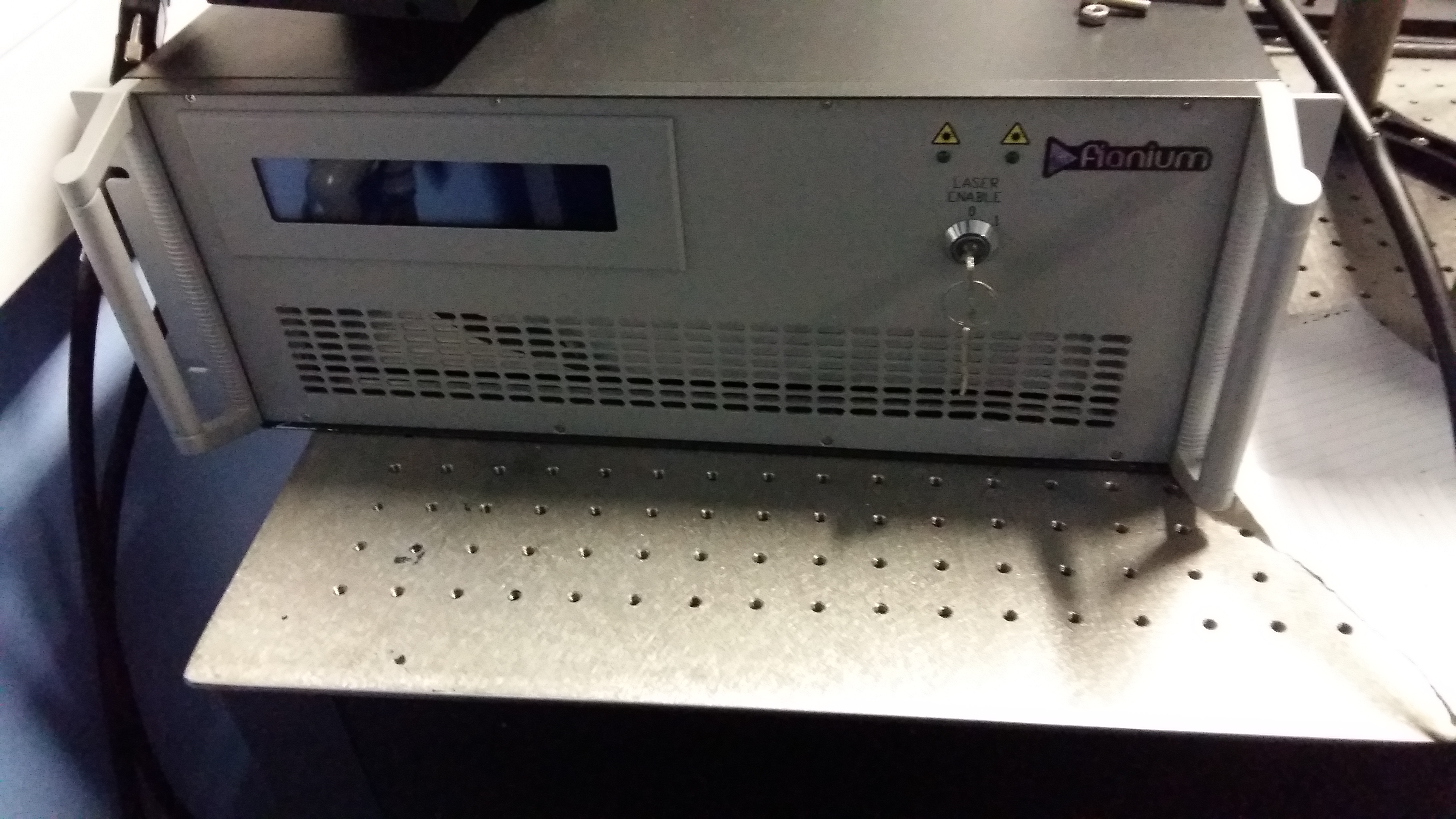
The Fianium HE-1060-10μJ-SP is an ultra-short pulse laser used primarily for micro- and nanostructuring of materials. This laser operates in pulsed mode only with a pulse width of under 5 ps, and a frequency of up to 0.5 MHz. This means that whilst each individual pulse is very low in energy, that energy can be transferred to the material over a shorter time period than it takes any heat to transfer . This results in surface ablation as electrons typically require >10 ps to transfer heat to the lattice structure (although this is material dependent). This is often referred to as ‘cold processing’ and leads to reduced melt and much cleaner etching. The low energy per pulse is compensated for by the high pulse frequency, whilst still maintaining comparatively low wattage.
Laser Wavelength: 1064 nm
High Energy Nd:YAG Laser (0.85 J)
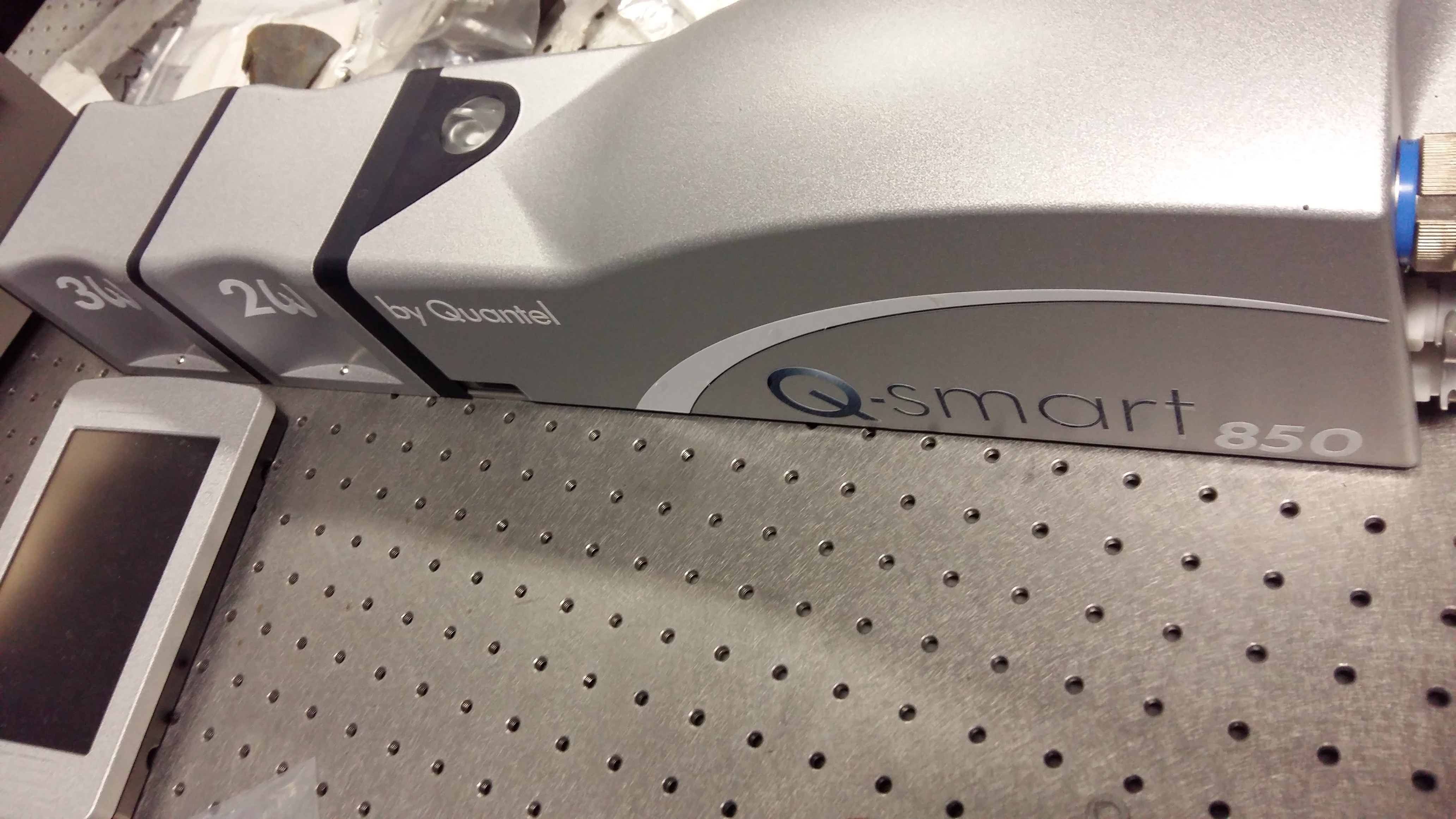
The Quantel Q-Smart 850 is a high-energy Q-switched Nd:YAG laser with frequency doubling and tripling options available. The laser operates in pulsed mode with a frequency of 10 Hz and a pulse width of 6 ns. Nd:YAG lasers have been used in applications ranging from surface processing/texturing, cutting/welding, laser shock peening (LSP), and additive manufacturing.
Laser Wavelength: 1064, 532 & 355 nm
Interested in working with us? We are always eager to collaborate with companies or academic colleagues. This could be on a strictly commercial basis, via development of a grant proposal (Innovate UK, EPSRC etc.), or simply experimentation towards a journal paper. Our extensive capabilities are highlighted in the commercial and research sections, please look there for details on what we can do for you.
For more information, to collaborate, or for a quote please e-mail: s.hodgson@chester.ac.uk